
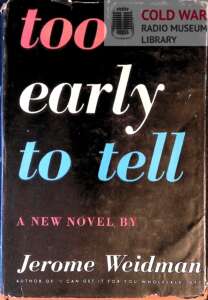
Thanks to the Cold War Radio Museum’s recent book acquisitions, I was able to read for the first time Jerome Weidman’s 1946 satirical novel, Too Early to Tell, which had been out of print and unknown to most Voice of America officials and journalists. It is a satire on the Office of War Information (OWI), the World War II U.S. government propaganda agency, also now almost wholly forgotten, even though it was in charge of Voice of America radio broadcasts. President Roosevelt created the agency in 1942 and put it under the control of the White House to counter Japanese and Nazi propaganda abroad and to influence American public opinion. In addition to the Voice of America, the Office of War Information had a robust domestic service until Congress defunded most of its domestic operations during the war, as fears arose among Republicans and some Democrats that VOA was taken over by pro-Soviet radicals and the Roosevelt administration was using it to target Americans with partisan political propaganda designed to create support for appeasing Joseph Stalin and influence the outcome of U.S. elections.
Weidman’s Journey from Poverty to Propaganda
Born in 1913 to working-class Jewish immigrants in New York City, Weidman’s early life was steeped in struggle. His father, a tailor from Austria, and his mother, a cigar factory worker from Hungary, raised their family on the Lower East Side amid economic hardship. Weidman graduated high school as valedictorian and turned down a scholarship to Harvard to support his family while studying at City College and NYU Law School. By the age of 19, he had published his first short story, and by 24, his breakout novel, I Can Get It for You Wholesale, had become a bestseller.
During World War II, Weidman was recruited by the Office of War Information as a psychological warfare expert and instructor. He trained propagandists at OWI’s Long Island school and spent time at Bletchley Park in the UK, where he was taught by British specialists in wartime messaging. He later served in Washington, evaluating the effectiveness of propaganda in Asia. Although he did not write VOA broadcasts himself, he worked closely with OWI officials and helped train personnel who did.
Weidman described his job at the OWI during the war as focused on propaganda abroad–”instructing a variety of Allied nationals in the techniques of psychological warfare directed against the German and Japanese enemies.”1 “Many of these men and women,” Weidman wrote, “were soon to broadcast the voice [sic.; the word voice was not capitalized.] of America to the people of Conquered Europe from London and Algiers.” Others were also hired “to write the leaflets signed by the Allies that were dropped on Occupied Norway and France.”2 Weidman explained that they were refugees who had escaped from countries conquered by Germany. Some were already American citizens.3
Too Early to Tell: Fictional Satire, Factual Critique
Weidman’s novel Too Early to Tell is set at a fictional “Bureau of Psychological Combat,” a stand-in for OWI. Through the eyes of protagonist Lily Chace, Weidman satirizes the self-satisfied, ideologically muddled, and often incompetent bureaucrats running America’s propaganda programs. Many of these characters were based on real individuals, such as Robert E. Sherwood, President Roosevelt’s speechwriter and OWI’s top overseas operations official, Joseph Barnes, the journalist in charge of VOA, and Elmer Davis, a former CBS analyst and OWI director.
The novel’s tone is sardonic, but the message is clear: the OWI often failed in its stated mission, not because of lack of resources, but because of misplaced priorities, political bias, and a disturbing tendency to idealize Stalin’s Soviet Union. Weidman coined the term “ideological infantilism” to describe the behavior of propagandists who mimicked totalitarian messaging methods—albeit in service of a different ideology.
The novel’s title itself is drawn from a speech by a fictional OWI manager, who tells trainees, “It’s too early to tell… but from where we sit, up on top, where we can see the whole picture, it looks like a damned fine job we’re doing.” It’s a line dripping with irony, meant to lampoon the agency’s habit of declaring success without accountability.
Fellow Travelers
During World War II, the Office of War Information oversaw the Voice of America’s radio broadcasts to overseas audiences. They originated from New York, although they then aired under different names. The Voice of America name was not used in initial broadcasts and was not officially adopted until after the war. Once the American and other Allied troops launched military operations in North Africa, some OWI radio broadcasters were dispatched abroad to originate radio programs from medium-wave transmitters located closer to the battlefronts.
Memoirs written by former Voice of America broadcasters who worked in New York during the war leave no doubt that they were particularly eager to travel abroad on behalf of the U.S. government. In his novel, Weidman makes fun of the students of the Bureau of Psychological Combat Training School for buying expensive luggage in anticipation of their foreign assignments. It gave their owners, he wrote, “the feeling and the appearance of men and women who … were now traveling far and fast, preferably by air, on missions of great military consequence.”4
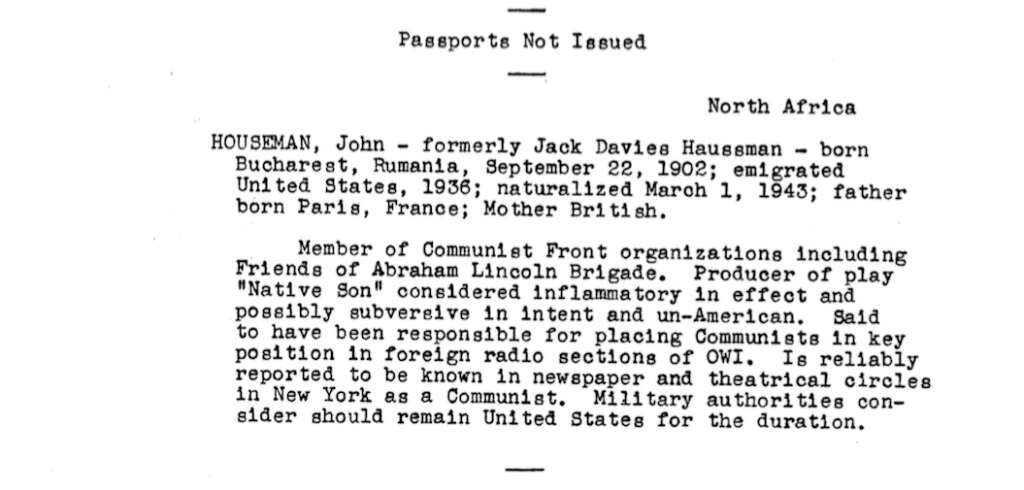
John Houseman, the chief producer of Voice of America programs in New York, was later somewhat inaccurately declared as the first VOA director. However, he was not responsible for program content. He was among many OWI employees in New York who had hoped to take advantage of the new opportunity to travel to North Africa in 1943 on government business. Another Voice of America wartime employee eager to travel abroad was Houseman’s protégé, Howard Fast, whom Houseman put in charge of writing VOA English newscasts. However, much to their surprise and distress, the State Department denied their requests for U.S. passports.
The official Voice of America biography makes no mention of Houseman being refused a U.S. passport and forced to resign. Still, he was too pro-Soviet even for the pro-Soviet officials in the Roosevelt administration. The U.S. military intelligence and the State Department rightly suspected him of hiring Communists for broadcasting jobs.
John Houseman could not have learned much more had he attended one of the psychological combat training courses described in Weidman’s satirical novel. He was already an expert in psychological warfare, having produced in 1938 Orson Welles’ fake news radio play War of the Worlds, which had created panic among some listeners in the United States who were convinced the alien invasion of their country was real. This experience helped him land a job at the Voice of America. He regretted, however, that “psychological warfare could not furnish me with the theater’s climaxes…; there was no applause for the Voice of America.”5
Refusing to issue U.S. passports for official government travel abroad was an elegant way of forcing John Houseman, Howard Fast, and several other communist and pro-Soviet OWI employees to resign. Howard Fast, VOA’s first chief news writer and editor, was a member of the Communist Party, and later, until his break with the party in 1957, one of its well-known party activists and journalists. Houseman and Fast resigned from the Voice of America, Houseman in mid-1943, and Fast in early 1944. Houseman became a successful Hollywood actor, and Fast, already a bestselling novelist, spent several months in a federal prison in 1950 after being convicted of contempt of Congress. In 1953, he received the Stalin Peace Prize.
Lily Chace – A Skeptic in Weidman’s Novel
The main character in Weidman’s book is Lily Chace, a twenty-six-year-old secretary with a college degree, who holds a low opinion of the teachers and students at the psych-op school and the propaganda materials they create.
Lily didn’t know what was wrong. She knew only that she wasn’t convinced. With discomfort she admitted to herself that, is she were a girl in Occupied Norway or France, she knew pretty accurately what she would say if she saw one of these films [World War II Hollywood films such as Mission to Moscow, which exonerated Stalin as responsible for the Soviet show trials] or picked up one of these leaflets or airborne newspapers. It was a single word. Short and satisfying. The word she never used aloud.6
John Houseman did not think much of Weidman’s satirical book, Too Early to Tell. In a 1979 interview, he said that Jerome Weidman “wrote a novel of which his hero worked at the OWI, but there was nothing there.”7
Lily Chace picked up on the Marxist terminology in the titles of OWI propaganda leaflets proposed by the OWI trainees. They were usually addressed “To the Silk Workers of Milan,” “To the Fishermen of Norway,” to “The Railroad Workers of France,” or, as Weidman put it, “when the students were inspired to a sudden burst of creative energy”– “To the Women Washroom Attendants of Marseilles.”8
Eisenhower on OWI’s Insubordination
Overall, the Office of War Information psychological warfare and Voice of America broadcasts–at that time under the heavy influence of radical Leftists, fellow travelers, and Moscow’s propaganda–did not help to shorten World War II. The Germans and the Japanese held out until the bitter end, giving up only when their total military defeat was imminent. The Office of War Information’s psych-ops and VOA broadcasts may have helped to blunt Nazi resistance during some local military operations, but, the then Supreme Commander of Allied Expeditionary Force of the North African Theater of Operations and later U.S. President Dwight D. Eisenhower, suggested in his memoir, published after leaving the White House, that OWI’s Voice of America radio broadcasts risked putting the lives of American soldiers in danger:
During World War II the Office of War Information had, on two occasions in foreign broadcasts, opposed actions of President Roosevelt; it ridiculed the temporary arrangement with Admiral Darlan in North Africa and that with Marshal Badoglio in Italy. President Roosevelt took prompt action to stop such insubordination.9
Even John Houseman admitted in one of his memoirs that “General Eisenhower was heard to complain that the Voice of America was doing more harm to the Expeditionary [American and other allied forces] than to enemy morale.”10. Houseman added that some weeks later, Eisenhower asked the Voice of America to launch a major propaganda assault on the Axis, but he did not specify the conditions under which it should be launched. In another book, Houseman quoted from a front-page article in The Chicago Tribune, which he described as “anti-[Roosevelt] Administration”:
It is known that General Dwight Eisenhower, Commander of North African Expeditionary Force, has appealed to the War Department for protection against the American propaganda being distributed by Sherwood’s [Robert E. Sherwood who in addition to being head of overseas propaganda and radio broadcasts was also President Roosevelt’s speechwriter] O.W.I. on the ground that it is doing more harm to the expeditionary force than to enemy morale. The General has made it clear that he regards American Psychological Warfare as inept, puerile and silly…11
In 1943, U.S. military authorities decided that John Houseman should not be allowed to travel abroad for the duration of the war.12 The State Department reported to the White House that John Houseman was “said to be responsible for placing Communists in key positions in foreign radio sections of OWI.”13
New York Times Exposes Pro-Soviet Bias
Arthur Krock, The New York Times’ Washington Bureau chief, reported on July 27, 1943, that some of the officials in charge of the Voice of America and some of its journalists became agents of influence for the Kremlin through their willingness to accept and repeat Soviet propaganda to the detriment of U.S. national interest and national security.
The selections of opinions made by the OWI were drawn heavily from purely personal journalistic sources–otherwise undistinguished–which have opposed the President’s Vichy and North African policies and usually produce an “ideology” that conforms much more closely to the Moscow than to the Washington-London line.
The explanation [from OWI officials] also failed to deal with the high official view here that the New York shortwave department of the OWI [Voice of America] deliberately and constantly borrows from these sources to discredit the authorized foreign policy of the United States Government, or to reshape it according to the personal and ideological preferences of Communists and their fellow-travelers in this country.14
VOA Radio Listeners on OWI’s Pro-Kremlin Propaganda
Lily Chace, the protagonist of Jerome Weidman’s novel, was right in assuming that much of OWI’s propaganda was silly if not counterproductive. A Polish journalist working in London during World War II had this to say about Voice of America radio broadcasts:
With genuine horror we listened to the Polish language programs of the Voice of America (or whatever name they had then), in which in line with what [the Soviet news agency] TASS was communicating, the Warsaw Uprising was being completely ignored.
I remember as if it were today when the (Warsaw) Old Town fell [to the Nazis] and our spirits sank, the Voice of America was broadcasting to the allied nations describing for listeners in Poland in a happy tone how a woman named Magda from the village Ptysie made a fool of a Gestapo man named Mueller.15
There was one area in which the Office of War Information propaganda broadcasts by the Voice of America were effective. They did what President Roosevelt wanted them to do. They helped him to deceive Americans and the world’s opinion that Stalin was a trustworthy leader. They allowed Roosevelt to agree to the Soviet dictator’s demands at the Tehran and Yalta wartime conferences, thereby giving Soviet Russia effective control over East-Central Europe after the war by accepting, without challenge, Stalin’s empty promises of free elections and democracy. Sherwood, Houseman, Fast, and other pro-Soviet VOA propagandists helped to create the image of the Soviet Union as a progressive and peace-loving nation by censoring all news about Stalin’s atrocities and other communist crimes.
Truman Abolishes OWI by Executive Order
The OWI was criticized for being influenced by pro-Soviet and Communist sympathizers, particularly in its broadcasts to Eastern Europe and Asia. On August 31, 1945, President Truman issued Executive Order 9608, which abolished the OWI, effective September 15, 1945. Overseas broadcasting, including VOA, went to the Department of State. Domestic propaganda functions were terminated.
The OWI’s dismantling was also part of a broader shift in U.S. policy, moving from total wartime mobilization to peacetime diplomacy. The Smith-Mundt Act of 1948 (U.S. Information and Educational Exchange Act) legitimized U.S. government international broadcasting and cultural diplomacy, giving a legal foundation to VOA within the State Department. It also strengthened the security vetting of VOA employees and banned domestic distribution of VOA broadcasts to eliminate the risk of targeting Americans with partisan or foreign propaganda.
Under President Truman and later Eisenhower, the State Department began to replace pro-Soviet OWI-era staff. VOA hired refugee journalists from East-Central Europe—including former anti-Nazi and anti-Communist resisters—who had firsthand knowledge of Soviet totalitarianism and broad appeal in their native countries.
These new journalists shaped VOA’s Cold War identity, making it a credible source of uncensored news behind the Iron Curtain. Without them and Radio Free Europe and Radio Liberty broadcasters, communism in East Central Europe would have lasted much longer, possibly to this day. They helped to undo the damage done by the early Voice of America officials and broadcasters who helped President Roosevelt sell Eastern Europe down the river by agreeing to nearly all of Stalin’s demands. Thanks to President Truman, the Voice of America was first downsized and later expanded after pro-Soviet officials and journalists lost their jobs or retired.
A Warning for Today’s Journalists
When Pulitzer Prize-winning author Jerome Weidman sat down to write his 1946 satirical novel Too Early to Tell, he wasn’t just telling a story. He was issuing a warning—one that remains urgent for today’s journalists and the members of Congress responsible for overseeing U.S. government-funded media.
Weidman knew the U.S. government’s propaganda operation from the inside. What he witnessed was not a finely tuned machine of democratic persuasion. It was a bureaucratic labyrinth fueled by ideology, patronage, and self-deception. His novel, cloaked in satire, offered something rare: an honest insider’s account of how U.S. government media could lose its way—even while claiming to tell the truth.
Weidman’s insights are just as relevant now as they were 80 years ago. In a world saturated with disinformation, authoritarian propaganda, and state-run media, it’s easy to point fingers at Russia, China, or Iran. It’s harder—and more necessary—to ensure our own institutions remain above reproach so that they can respond adequately to the challenge of disinformation and propaganda from undemocratic regimes, authoritarian rulers, and terrorists. And that starts with understanding how and when we’ve failed before.
A Propaganda Agency with a Blind Spot
Weidman’s Too Early to Tell is a thinly veiled portrayal of OWI and the people who ran it. Through the eyes of a young secretary in a government propaganda school, he sketches a bureaucracy full of Ivy League draft dodgers, political opportunists, and true believers in Soviet communism willing to look the other way when it came to Stalinist atrocities.
Although Weidman was not directly involved in VOA broadcasting, he trained many who were. He observed firsthand how OWI’s internal culture leaned so far to the left that it promoted Joseph Stalin as a champion of peace and freedom. In the name of wartime unity, facts were omitted, censored, or distorted, particularly about Stalin’s crimes.
Weidman coined the phrase “ideological infantilism” to describe his colleagues’ blind devotion to their cause. He wasn’t alone in his concern, but he was nearly alone in his willingness to voice it.
Fast Facts: The Howard Fast Contrast
While Weidman used fiction to reveal the flaws in America’s propaganda apparatus, another OWI and VOA colleague—Howard Fast—chose a different path. Fast, a Communist Party member and later winner of the Stalin Peace Prize, was VOA’s first chief news writer and editor in 1943.
In his memoir Being Red, Fast admitted that he “refused to go into anti-Soviet or anti-Communist propaganda.” In practice, this meant that during his tenure, VOA actively censored information about the Katyn massacre, Soviet Gulag slave labor camps, and other Stalinist crimes.¹
Weidman, who satirized Fast under a fictional name in his novel, criticized this type of manipulation as fundamentally dishonest. For Fast, the message was the mission. For Weidman, truth—however inconvenient—was non-negotiable.
That difference matters.
Why It Still Matters
The Voice of America Charter, passed by Congress in 1976, mandates that VOA “will serve as a consistently reliable and authoritative source of news” and will present “a balanced and comprehensive projection of significant American thought and institutions.”² That commitment to objectivity is more than legal boilerplate. It’s a safeguard against the kind of ideological capture that plagued VOA’s earliest years.
Yet questions of bias at VOA remain. Some are fair; others are partisan distractions. But the history is undeniable: during World War II, a U.S. government media operation—funded by taxpayers and shielded from oversight—knowingly broadcast Soviet propaganda to foreign audiences. That happened. And it can happen again.
This is where Congress comes in.
It’s the responsibility of Congress to ensure that VOA and its parent agency, the U.S. Agency for Global Media (USAGM), remain faithful to their public service mandate. That means:
- Enforcing accountability: Metrics of success must go beyond audience size and include independent assessments of content quality, accuracy, and balance.
- Ensuring editorial independence: VOA journalists must be free to report without political pressure, but not free to pursue personal, ideological, or partisan agendas.
- Maintaining institutional memory: The lessons of history—like those chronicled by Weidman—must be preserved and studied, not whitewashed or ignored.
The Cost of Forgetting
Weidman’s novel was quietly shelved after its publication. It was too honest. It offended too many people in positions of power. While Hollywood and publishing were increasingly sympathetic to the Soviet Union, Weidman dared to show how easily idealism could be exploited—and how propaganda could slip into self-parody.
Meanwhile, voices like Howard Fast’s were amplified. His propaganda was celebrated in pro-Communist circles. Weidman, for all his literary success, was largely erased from the narrative about wartime media.
And yet it is Weidman’s voice we need to recover—not because he was perfect, but because he was honest.
A Final Word
If you are a journalist, Too Early to Tell offers a mirror. Are you telling the truth—or only the part of the truth that fits your worldview? Are you reporting independently, or unconsciously channeling the biases of your colleagues, your editors, or your preferred ideology?
If you are a member of Congress, Weidman offers a history lesson. Bureaucracies left unchecked become self-replicating. Missions drift. Narratives replace facts. And when that happens, the enemies of democracy don’t need to silence us—we do it to ourselves.
It’s not too early to tell. It’s exactly the right time.
NOTES
- Jerome Weidman, Too Early to Tell (New York: Reynal & Hitchcock, 1946), the author’s “Note.”
- Ibid., p. 2.
- Ibid., p. 3.
- Ibid., p. 18.
- John Houseman, Unfinished Business (New York: Applause, 1989), p. 247.
- Ibid., p. 9.
- Studs Terkel Radio Archive, “Interview with John Houseman,” broadcast December 14, 1979, https://studsterkel.wfmt.com/programs/interview-john-houseman.
- Weidman, Too Early to Tell, p. 8.
- Dwight D. Eisenhower, The White House Years: Waging Peace 1956-1961 (Garden City: Doubleday & Company, 1965) 279.
- Houseman, Unfinished Business, p. 250.
- An excerpt from The Chicago Tribune article in John Houseman’s Front and Center (New York: Simon and Schuster, 1979), p. 84.
- Under Secretary of State Sumner Welles April 6, 1943 memorandum to Marvin H. McIntyre, Secretary to the President with enclosures, Franklin D. Roosevelt Library and Museum Website, Box 77, State – Welles, Sumner, 1943-1944; version date 2013 and the National Archives State – Welles, Sumner, 1943-1944, From Collection: FDR-FDRPSF Departmental Correspondence, Series: Departmental Correspondence, 1933 – 1945 Collection: President’s Secretary’s File (Franklin D. Roosevelt Administration), 1933 – 1945, National Archives Identifier: 16619284.
- Ibid.
- Arthur Krock, The New York Times, “President Rebukes OWI for Broadcast on Regime in Italy,” July 27, 1943, pp. 1 and 5.
- Czesław Straszewicz, “O Świcie,” Kultura, October, 1953, 61-62. I am indebted to Polish historian of the Voice of America’s Polish Service Jarosław Jędrzejczak for finding this reference to VOA’s wartime role.
